07 Feb 2026
Draw what you want
Imagining workspaces and using creativity to explore wellbeing in cloud computing.
Context
As part of linking wellbeing to Cloud Computing, I wanted students to think about where cloud infrastructure actually lives and what it means to work in those environments. Rather than starting with policies or theory, we focused on workspaces - specifically data centres.
The aim of the session was for students to design their own workspace with employee wellbeing in mind, and to use that design as a way of explaining their thinking.
What we tried
Drawing
Students were shown examples of real-world data centres, including one from Microsoft that gives a virtual tour of the facility. This gave them a baseline of what a data centre actually looks like, rather than relying on vague mental images.
From there, students were asked to design their own version. They had access to computers, paper, and marker pens, but the emphasis was on drawing rather than producing something digitally polished.
What was interesting was the range of responses. Some students leaned heavily on realism of an actual data centre and its technology, while others went much further into what they would want from a workspace: open areas, plants, breakout spaces, natural light. Some students asked additional questions about what do we expect from the drawing, we even had one group create theirs in an alternative universe.
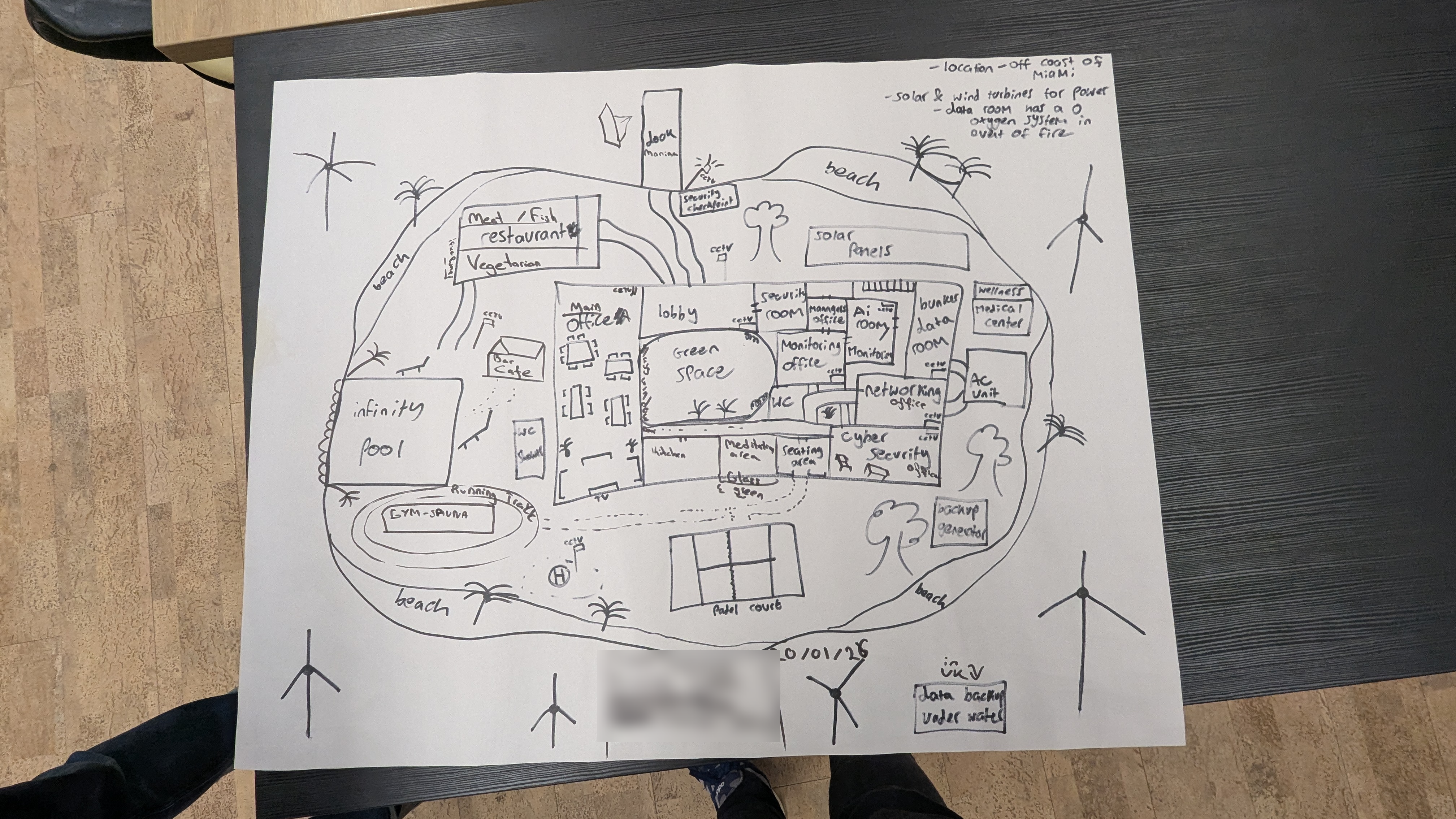
Drawing a data centre
Reflection
Computer Science doesn’t naturally invite creativity. Much of the subject is around theory or tools, and students are often conditioned to look for a “correct” answer rather than explore ideas. Giving students paper and pens removed that pressure slightly. Instead of worrying about syntax, formatting, or whether something would be assessed, they could focus on explaining why they made certain design choices.
Next time
There’s definitely scope to build on this. A digital or even VR-based version could allow students to create walkthroughs of their designs and explain them in more depth. Showing the work to other students and inviting feedback could also add another layer of discussion around differing expectations of work environments.
That said, I’d be cautious not to lose what worked here. The simplicity of paper and pen lowered the barrier to entry, and that felt important. It reminded me of a Year 7 Geography lesson where we designed a Utopia - not because the outcomes were perfect, but because the act of designing sparked far richer conversations than a worksheet ever could.
TL;DR: Sometimes the most effective way to explore ideas in Computer Science is to step away from computers altogether.