10 Nov 2025
Establishing classroom standards
Exploring different ways to crowdsource in-class expectations with students.
Context
At the start of a new module, I wanted to establish clear classroom standards by discussing expectations, this is a normal expectation as part of the way we conduct learning at the university, the idea is to find out:
- what staff expect from students
- what students expect from staff
The aim was to make these expectations explicit and shared, rather than imposed.
What I tried
I’ve experimented with a few approaches over time:
Open discussion
- Low setup
- High risk of opt-out
- Dominated by confident voices
I have previously completed this exercise by asking students to provide their answers verbally, it can work however responses generally come from those with more confidence or maybe you might have students where English is not their first language which could mean they’re less likely to speak out in front of the entire class. There is also the high chance of students opting out of this exercise. The benefit of doing it this way means there is no prep, it’s traditional in terms of classroom dynamics.
Paper-based responses
- More inclusive than discussion
- Time consuming
- Requires printing and handling paper
I am generally less inclined to use paper in the classroom because it can be extra resource to organise, pens/pencils to find and as a digital-first subject, Computer Science, I often prefer digital solutions but I wanted to give it a go anyway. So, when attempting to use paper for this sort of activity I’ve used large sheets and post-it notes that way they can be handed out to students along with a pen/pencil and they can choose where to place it.
During my time in secondary school I used to use my whiteboard and found that students turned it into a competition to see who could get their post-it note as far up the wall as possible so to combat that I would draw the outline of a box and remind students to place it inside the box, if it’s outside then it’s not included in the discussion.
An activity in this format means students have to get out of their seats, Computer Science lends itself to be a chair and desk subject so how do we get students moving around?
Digital tools
- Some setup required
- Students can easily author how they want the classroom to work
- Anonymisation lowers the barrier to honest input
If you use a tool like Vevox you can get anonymised answers from your audience, this can be helpful by reducing the stress of being identified for the work you have done. What I have observed between school and university is that students are more likely to answer if there name is not attached.
We looked at what does respect mean to the students, this gives us a good baseline of what they understanding and we can discuss it by asking questions like - what does honour look like in the class context.
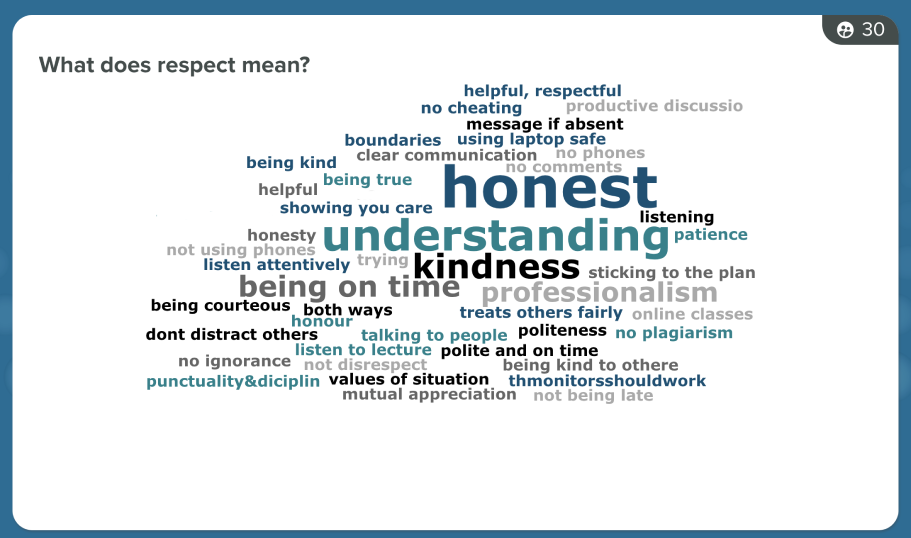
Vevox - What does respect mean? Word wall style question
The next question was what do the students expect from us as lecturers? This can open up a few different avenues but the feedback is generally: respect, punctuation and engagement which could be make it more interesting, don’t read from the slides and most importantly make it relevant.
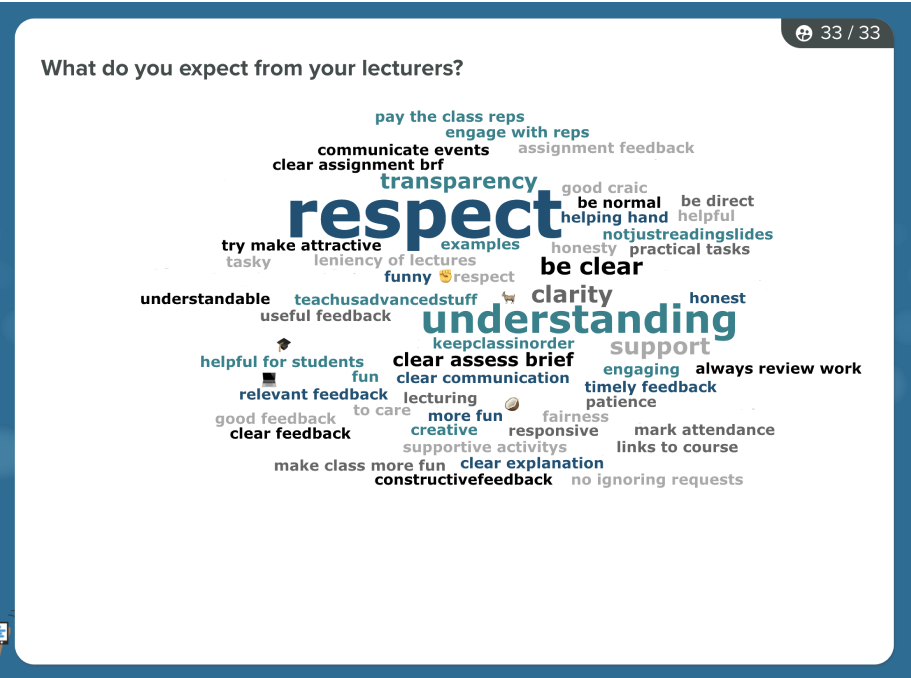
Vevox - What do you expect from your lecturers?
Reflection
Giving students the opportunity to create their own classroom standards seems to contribute to a more respectful environment. Anonymisation presents better, more authentic responses to questions, making it low-stakes.
Next time
I would default to a low-friction, anonymous digital approach and use the outputs as a starting point for a brief whole-class discussion. It’s important to recognise that as mentioned earlier on you’re more likely to get responses where thoughts/words aren’t associated with a singular person.
TL;DR: Anonymised crowd sourcing gives more input than verbal/written responses